Flexible bottle supply for Remia: Transforming into a top sport
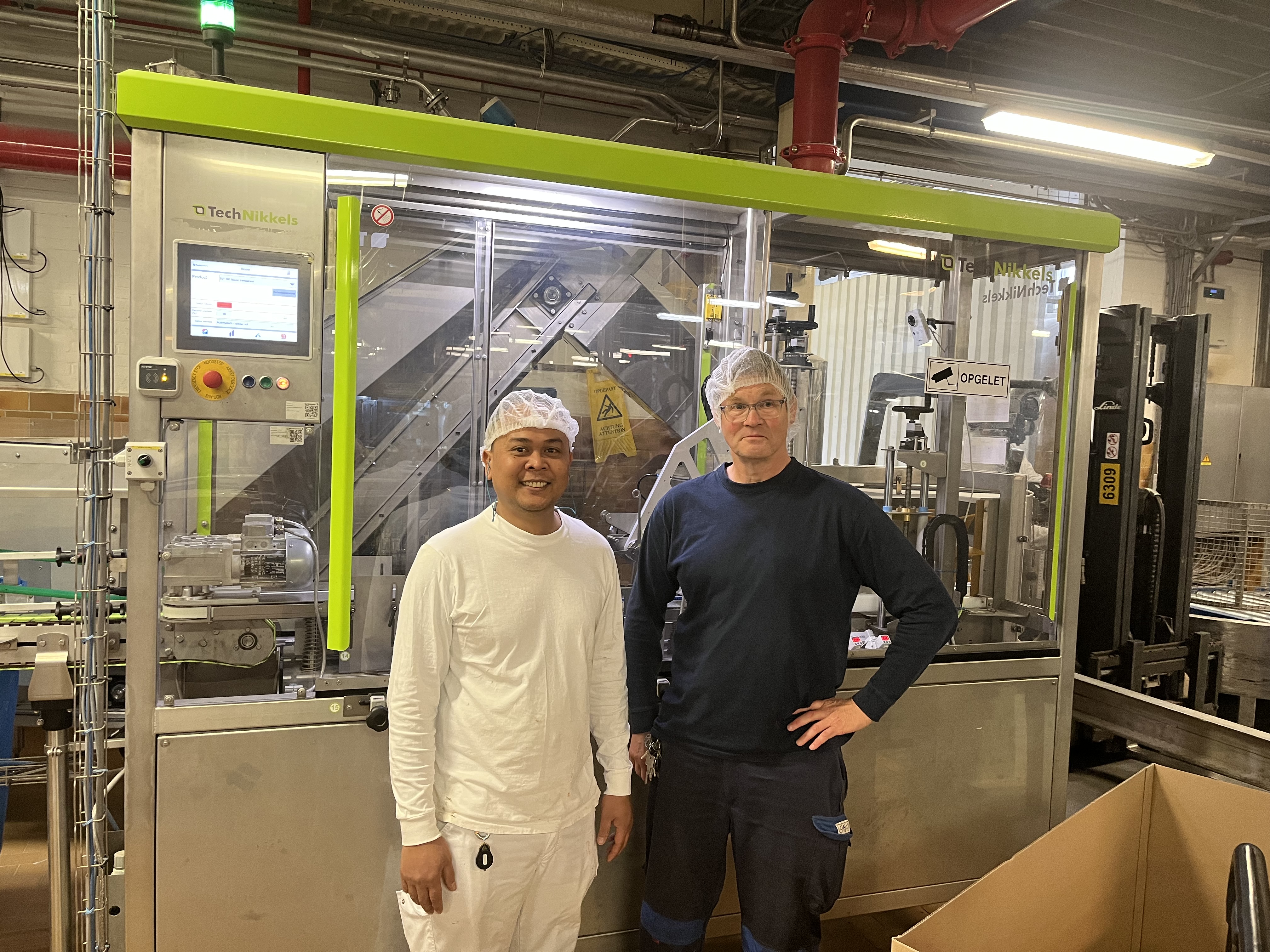
Remia was looking for a flexible solution for processing various bottle sizes on one line. TechnikKels supplied a user-friendly bottle setter that ensures a continuous supply without glitches. The result is a streamlined process with less downtime and a significantly higher return.


For example, Remia processes 14 formats over one packaging line
Remia has been a well-known name in the Netherlands since 1925, but also far beyond. A wide range of sauces, dressings, frying fats and margarines is produced in Den Dolder, the sauce heart of the Netherlands. Read an interview with Remia about the collaboration with TechnikKels below.
Remia's challenge
Remia's sauce factory in Den Dolder is growing rapidly. The family business has been around for almost 100 years and is in full development. Ed Oostveen, assistant head of technical service, has been working there for 35 years. Ed: “When I started, we got cakes at the end of the week when we had filled 100 tons. It now takes us 6 hours to do that.”
When Remia wanted to build a new production line 3 years ago, they were looking for a bottle erector that can handle many sizes. They found them at TechnikKels.
Jan van Ledden, production manager at Remia says: “The challenge in the sauce factory is that we have to run many sizes of bottles over one setter. It is difficult to get 250 milliliter and 1 liter bottles and everything in between properly on one production line and on one packaging line. We really wanted to make an improvement in that and we were of the opinion that TechnikKkels could do that best.”
For us, conversion is top sport
Remia fills 200 bottles per minute and has 14 different packages running on the same page. Flexibility is therefore very important. Jan: “Flexibility is a core value at Remia. We want to be able to continuously shift to serve our customers in the best possible way. The simplicity of the TechnikKels machine is also a strength. We convert them at least three times a week. That conversion is really top sport here.”
Colleague Ed Oostveen adds: “We also call it a pit stop. All conversion steps have been fully developed, step by step. With every change, the operators know exactly what to do. We have instructions for each machine, how to go from size A to format B. And it's in the TechNikkelS display. The operators step through the menu. You can't do it wrong.”
The number of formats is therefore large. And that is certainly not going to be less. Jan: “With the takeovers of Gouda's Glorie and Yildriz by Remia, formats have been added again. And that's how the market works. Many products are restyled after about 5 years, sometimes earlier. Such a new bottle needs to be put back on the line. We're good at that too. If I now get a new format for a TechniKkels or a filling machine, we can adjust that quickly. You have to keep the factory running efficiently, even though you have to make a lot of conversions.”
Ed: “We do have a new format of four or five per year. Or that a format should go from line A to line B, because there is more space there. Our machines must therefore be able to accommodate a wide range of sizes. TechniKkels fits in very well with that. And the spare parts are not expensive. A conversion kit from another machine may cost up to 10K. At TechnikKkels, you only lose 2000 euros. That makes a big difference”
“It really boosts the line's efficiency”
The flexible bottle setups also ensure less production loss. Jan: “Setting up is crucial in supplying the bottles to the filling machine. If there are big gaps between them, which was often the case in the past, you have a lot of downtime. With TechnikKkels, we have a good connection with the following machine. It runs more smoothly. It really boosts the efficiency of the line.”
In addition to the required flexibility and cost savings, the ease of operation also plays a major role in choosing Remia. Jan: “The TechnikKels bottle setter is not complex, so operators learn it quickly, the technical service learns quickly. This is an advantage that the machine can be learned quickly for staff.”
Ed: “If you spend a week on that line, you already know a little bit about how to convert the machine and how to adjust it.”
“Circumstances are always changing”
Jan: “We also look at that with new machines. Is it easy to adjust? We've come back a bit from having that done completely automatically. Putting everything into a program, pressing a button and it works all at once, that doesn't seem to be the practice. A mechanical adjustment part is always required to get it right. Circumstances are constantly changing. When it is warm in the factory, it can have a different effect than when it is cold. Bottles do not always arrive constantly, sometimes they are blown a little thinner, for example. Then you immediately have a problem. And we have coated and uncoated bottles. Sometimes we sleep and sometimes we label. So sometimes you have to adjust the same type of bottle differently. If you can do that by hand, it's really nice.”
Ed: “We're going back to basics, everything as simple as possible. You do need electronics, but you also need to be able to adjust by hand.”
“Getting all those formats right on one production line”
Implementing a new line with so many different bottles is not an easy project. Jan: “In the beginning, we did have some startup problems. Because it's really a challenge to get all those formats right on the production line. Each bottle has its own challenge. And there are always some really tough ones out there. But we were delighted with TechNikkels' service, their commitment and their willingness to discuss improvements with us.”
“We listen carefully to TechNikkelS and TechNikkelS listens to us carefully. For example, we've experimented a lot with new tyres. They also listened to us there and so we quickly took steps to improve. They now do one of the modifications that our engineers have applied to all machines. They're really open to that.”
“Staff party”
Ed: “The mechanics are also very happy with them. They feel Technikkels' involvement. At one point, on a Friday evening, they called someone's private number and there was just a staff party at TechNikkels. But we needed a motorcycle. Then they said, “I can't bring him now, but if you drive here, he'll be ready behind the gate in an hour.”
Jan: “They could also have said: “We're having a staff party now, that's not possible.” But they didn't do that. They helped us anyway. That is what we like very much. Just want to go the extra mile.”
“Growth is turbulent”
And Remia hasn't grown up. Hard work is already underway to increase production capacity. Jan: “The growth is turbulent. We are currently expanding again. In the sauce factory, we purchased two new production lines. We had to do a substantial expansion for that and a new floor has been built in the factory. That is our most important project right now. We need to recruit staff for it, it's not easy these days. And buy new machines. So we still have a few great challenges there.”
Ed: “For the new line, we have purchased another TechniKkels setup. It will be installed in November. That's the third one we've run then.”